

The Last Undervalued Layer in Women's Soccer

Investors have already repriced the club. The market is repricing the player right now. The last layer still mispriced is the one that develops her. The value is there. The mechanism to pay for it is not.
When Alexis Ohanian looked at the NWSL in 2020, he saw the numbers that did not add up. Megan Rapinoe's club, the Seattle Reign, had recently changed hands at a reported valuation of about $3.5 million. Rapinoe alone, he argued, was worth at least that much every year in marketing. The franchises were being priced with no regard for the sport's commercial power. They were badly undervalued.
He came in as a lead investor when Angel City launched in 2020. The club is now valued at a reported $300 million. His framing was never charity. He treated it as cold capitalism with profitability as the goal. The franchise value had been sitting in plain sight the whole time. The price simply hadn't reflected it yet.
The proof came fast. The same Reign that changed hands for about $3.5 million in 2019 sold again in 2024 for a reported $58 million.
That gap between real value and lagging recognition has been closing across women's soccer one layer at a time. The order in which it has closed is the useful part, because it shows where the next opportunity is.
The club got repriced first
The valuations came first. Angel City's rise is the headline version, but the whole league moved with it. Investment, media deals, and franchise valuations have all climbed. Capital saw the club as an asset before it saw anything else, because a club is the easiest thing to put a price on. That layer has been recognized and priced accordingly.
The player is being repriced now
The second layer is the player, and the market is correcting it in real time. Denver Summit FC paid a reported $450,000 to sign Ayo Oke, the most an NWSL club has reportedly paid to buy back a U.S. player who first turned pro in another country. Chelsea paid Angel City a reported $1.3 million for Alyssa Thompson, a club record. Nike signed her youngest sister, Zoe, to a name-image-likeness deal at 14. Players who were priced at nearly nothing a few years ago now carry fees and endorsements that look like the men's market did a generation ago. That layer is being recognized at an accelerated rate.
The last layer is development
Beneath both sits the layer that must be priced before the next wave of expansion and valuations: the infrastructure that develops the players. This is the last undervalued layer in women's soccer, and the reason is different from the others. The club was underpriced because investors had not recognized a staggering market inefficiency. The development layer is underpriced for a different reason: the incentive to invest in it has only recently become real, and the system to capture that value is still being built. Even though this opportunity is the foundation of the international soccer business model, it has not yet been valued in the women's game.
Follow one player to see the size of what goes unpaid.
Alyssa and Gisele Thompson were the first girls to train with Total Futbol Academy's MLS NEXT boys' academy program because that was the highest level of development available to them. Both signed their first professional contracts with Angel City straight out of high school. Alyssa went first overall in the 2023 draft; two years later Chelsea bought her for a reported $1.3 million.
In almost every other soccer nation, two payments would have flowed back to the clubs and academies that developed her, and neither one is a transfer fee. The first is training compensation: when a player signs her first professional contract, the buying club pays the youth clubs and academy that trained her between the ages of 12 and 21, on a published per-year scale. The second is the solidarity mechanism: when a player is later transferred for a fee, 5% of that fee is distributed back through every club that trained her, year by year. A transfer fee is different. It pays the selling professional club to release a player still under contract. Training compensation and the solidarity mechanism pay the developers beneath that professional club, for the years of work that created a valuable asset in the first place.
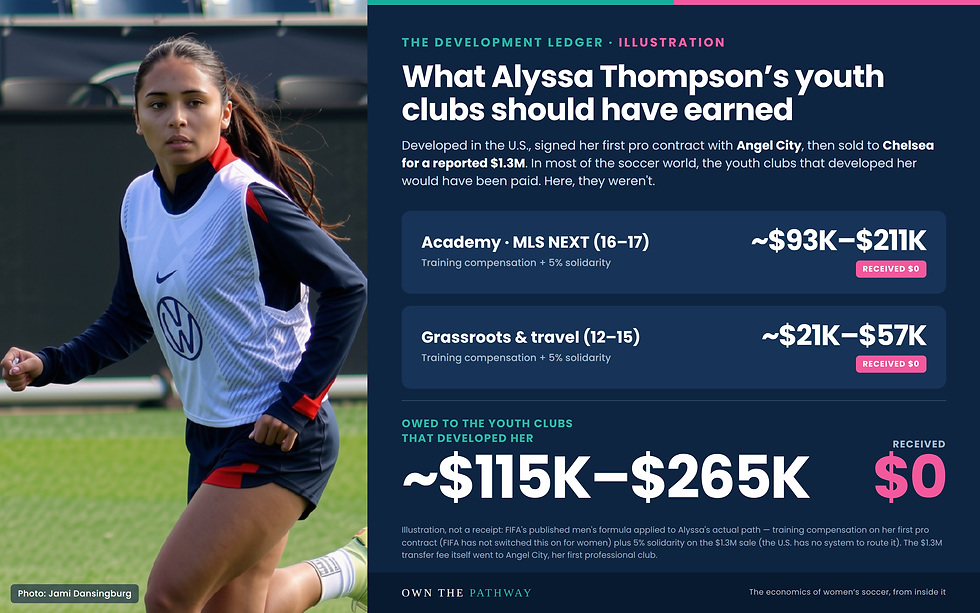
Here is what those mechanisms would have returned along Alyssa's pathway if they were applied for her here. Treat these figures as an illustration, not a receipt, because two separate structures are missing for women. Globally, FIFA has not switched on training compensation for the women's game; it approved a framework in 2024 that is not yet operating. Domestically, even the solidarity mechanism, which does apply to women's international transfers, has nowhere to land: U.S. Soccer has no system to identify the clubs that developed a player and route the money to them. To size the gap, we apply FIFA's published men's formula to Alyssa's actual path.
On Alyssa's first professional contract, the youth clubs that developed her from 12 to 17 would have been owed somewhere between about $88,000 at the rates set for U.S. clubs and about $240,000 on the European scale. On the Chelsea sale, the solidarity mechanism would have sent another 5% of the $1.3 million fee back down the pathway, roughly $26,000 to those same youth clubs. Added together, the youth clubs and academy that made Alyssa Thompson should have received on the order of $115,000 to $265,000 for developing one player.
The $1.3 million transfer fee went to Angel City, her first professional club. That is the pro market working as designed. The developmental layer beneath it received nothing. The grassroots club, the academy that took the first girls into its program, the pre-professional side she came through: none of them collected a dollar, because the structure that would identify them and route the money barely functions here. The value was created. The check was written. It went somewhere else.
Now multiply. Gisele signed a first professional contract too. Zoe is 14 with a Nike deal and a career ahead of her. Every academy in the country is developing players whose value is about to be recognized at the club level and the player level, while the development level stays off the books.
The opportunity
This is the same pattern Ohanian named, one floor lower. The value at the development level is not speculative. The market is already paying for it, in transfer fees and endorsement deals, to everyone except the developer. What is missing is not proof of value. It is the mechanism that lets the clubs that create it share in it.
The layer the rest of the market has not priced yet is the layer where the players are actually made. It is undervalued not because the value is absent, but because no one has built the structure to reward it for women. Build that structure, and the money now leaving the pathway could stay in it, and fund the next player, here.
Sources
Front Office Sports (Alexis Ohanian interview) — his reasoning that the NWSL was undervalued: the Seattle Reign's low sale relative to Megan Rapinoe's marketing value; investing as "cold capitalism," not charity.
ESPN / Equalizer Soccer (Dec 2019) — OL Groupe (Lyon) acquired Reign FC at a reported ~$3.51 million valuation.
CBS Sports (2024) — Seattle Reign sold again for a reported ~$58 million.
NBC News (2024) — Bob Iger and Willow Bay took a controlling stake in Angel City at a $250 million valuation; club widely reported at ~$300 million.
ESPN — Chelsea sign Alyssa Thompson from Angel City for a reported ~$1.3 million (club record); Denver Summit FC sign Ayo Oke for a reported ~$450,000.
ESPN — Zoe Thompson, 14, signs a Nike NIL deal.
ESPN / CBS Sports — Alyssa and Gisele Thompson developed via Total Futbol Academy MLS NEXT (first girls to do so); signed first pro contracts with Angel City out of high school; Gisele extended with Angel City through 2029.
FIFA training compensation and solidarity mechanism (per-category annual rates; solidarity is 5% of a transfer fee distributed across the clubs that trained the player).
Equalizer Soccer (Sep 2025) — NWSL commissioner Jessica Berman announces a rolling expansion process; continued expansion is public.
FIFA Circular 1885 (2024) — women's football training-compensation framework approved; system not yet operating.
Accuracy note: The training-compensation and solidarity figures are an illustration applying FIFA's published men's formula to Alyssa Thompson's actual pathway. They are not amounts any U.S. club received or is legally guaranteed. Training compensation is not yet applied to women's football by FIFA, and the United States has no domestic system to route the solidarity mechanism to developing clubs, which is the point.


Comments