

It Starts With the Player Pass

Before you can understand why player development doesn’t pay in this country, you have to understand something more basic: how the United States even keeps track of who a player is and where she has played. It begins with a small laminated card — and it explains a great deal.

Everything else in this educational series — the pathway, the economics, why the money the rest of the world reinvests in to developing clubs is so hard to capture here — rests on one unglamorous question: who is keeping the record? In soccer, the answer starts with the player pass.
Let’s start there, because once you see how registration works in the United States, the rest of the maze makes more sense.
Player pass explanation
A player pass (you’ll also hear “player card”) is an official identification document tied to a registered player. It carries her name, photo, date of birth, a unique player ID, her club and league, and the season it’s valid for. It does three useful jobs: it verifies age and identity, it provides registration and insurance, and it establishes eligibility to play in sanctioned games.
None of that is controversial. Every national system needs a way to confirm that a player is who she says she is and is eligible to be on the field. The question is not whether to have player passes. It’s who issues them — and here is where the United States is different from almost everywhere else.
One country, many registries
The U.S. Soccer Federation is the national governing body. But it does not run a single registration system. Instead, it recognizes a whole set of affiliated organizations that register players and issue passes — and, to a real degree, compete with one another for those players.
On the youth side alone, a player might be registered through US Youth Soccer, US Club Soccer, or AYSO, with competition platforms like MLS NEXT and ECNL layered on top. Move up the ladder and you reach adult amateur play through the US Adult Soccer Association, and the professional game through USL, MLS, and NWSL. Many of these are private organizations, each with its own registration system, its own player pass, and its own reasons to want a player inside its ecosystem.
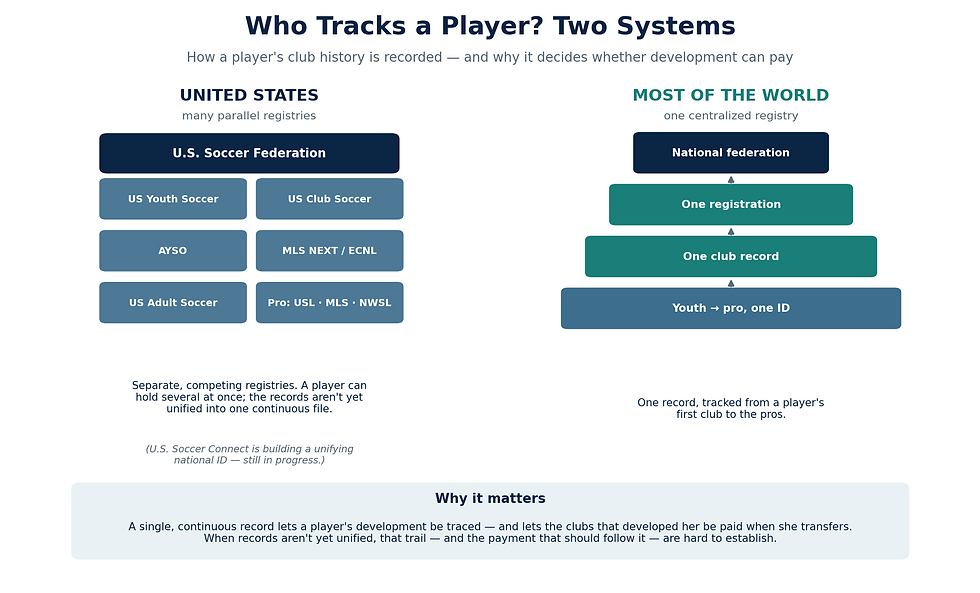
Who tracks a player? The U.S. runs many parallel registries under U.S. Soccer; most of the world uses one centralized registry.
Because those systems are separate, something becomes possible here that would be unusual almost anywhere else: a single player can hold more than one registration at the same time. She might be registered for the season with a club that plays in a US Youth Soccer league — and also hold a US Club Soccer pass so she can play tournaments, appear as a guest for another team, or move between teams without a formal release from the first. In most of the world, that’s it: your club is your club, one registration, one record. Here, registration is closer to a marketplace.
U.S. Soccer is the singular national governing body on top of all these organizations. It has built a national ID layer — U.S. Soccer Connect — to give each player a single national identity, and its current “Path Forward on Player Registration” review is aimed squarely at making the record more unified. The federation is working toward the single thread the rest of the world already has; it just isn’t fully there yet.
One country, one record — everywhere else
Step outside the United States and the picture is strikingly simpler. Most soccer nations run a single, centralized registration under one national federation: one pyramid, one club record, one continuous file that follows a player from her first youth team all the way to the professional game. FIFA has pushed this further with a global player-ID system designed to give every player one identity across borders.
That single thread is the quiet foundation of the global game — and, as we’ll see, of its economics.
The trade-offs of choice
The U.S. approach has genuine strengths: it verifies ages and identities, it provides insurance, and the competition among organizations can push them to better serve families. This choice has value. Competition for players keeps fee prices in check, and these organizations can be more agile in their support of a diverse national player pool.
But the fragmentation carries real costs. There is a fee to register at essentially every level and with every sanctioning body — one more charge stacked onto a pay-to-play system. The records are not yet unified into a single continuous file, so a player’s history can be spread across several organizations rather than sitting in one place. And the whole process can be opaque and intimidating, especially for newer immigrant families — with the result that talented kids who lack the required paperwork or the money or the guidance can be left outside the system entirely — talent that never enters the pipeline.
Why this is the foundation
Here is how it connects to everything else in this educational series. The global mechanisms that create low-cost sustainable development systems — training compensation and solidarity payments — run on exactly one thing: a clean, continuous record of which clubs developed a player. That record is what lets the money find its way back to the people who did the developing.
When a player’s history is spread across competing private registries, that trail is hard to piece together. Until the record is unified, you cannot reliably answer the most basic question — who developed this player? — and if you can’t answer that, you can’t send the reward to the clubs that earned it. So the fragmented player pass isn’t a bureaucratic footnote. It is one of the first reasons development doesn’t pay for itself here.
The encouraging part: this is fixable, and the will to fix it is building. U.S. Soccer has an active review of its own ecosystem aimed at a more unified path forward on player registration — a recognition that the record itself is worth getting right.
The player pass looks like a small thing — a card in a coach’s binder. It’s actually the ground floor of the entire pathway. Get the record right, and everything above it — tracking, compensation, a system that funds the next generation — becomes possible.
Sources
• U.S. Soccer Federation, Ecosystem Review — Path Forward on Player Registration — ussoccer.com
• US Club Soccer, Player Registration — usclubsoccer.org
• US Youth Soccer — usyouthsoccer.org
• U.S. Soccer Connect — the federation’s national registration platform and player-ID system — ussoccerconnect.com; and SoccerWire’s coverage of its launch.
• FIFA Connect (the global player-ID / single-registration framework U.S. Soccer’s national ID builds on) — FIFA.
• “Everything You Need to Know About Player Cards in Youth Soccer,” Anytime Soccer Training (lay overview) — anytime-soccer.com

Comments